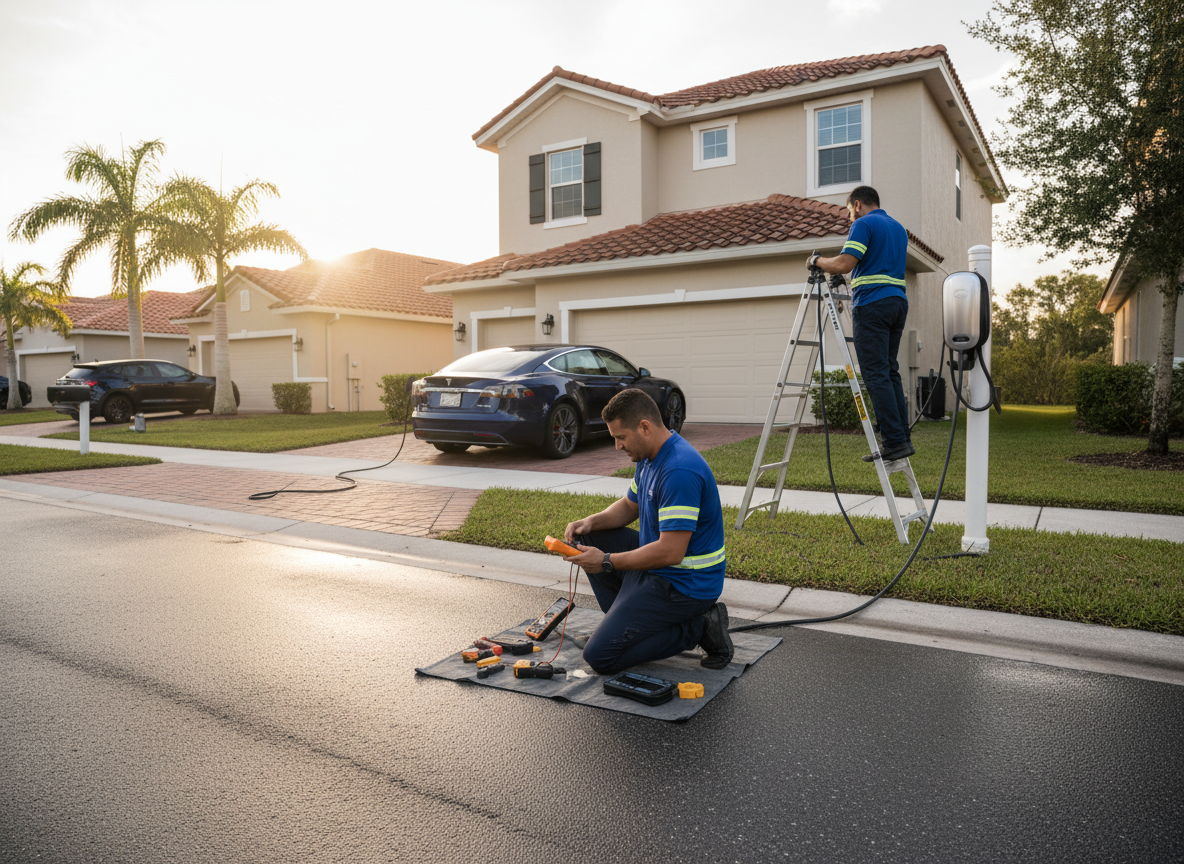
Sanford's mix of historic homes in the Sanford Historic District and newer builds near Lake Monroe often means electricians encounter knob-and-tube remnants or undersized panels that cannot support Level 2 chargers without upgrades. Hot humid summers accelerate corrosion on outdoor receptacles and connectors, so proper NEMA-rated enclosures and GFCI protection become essential on every job. Electricians working in Celery City and Downtown Sanford routinely check soil moisture around buried conduit runs because standing water from afternoon storms can degrade insulation faster than in drier inland spots.
Code compliance in Seminole County requires permits for any new 240-volt circuit feeding an EV charger, and inspectors focus on proper conductor sizing when the panel sits more than 50 feet from the charging location. Homeowners in Lake Mary and Heathrow frequently request charger relocation after initial installation because the original spot sits too close to irrigation lines or faces direct western sun that bakes the unit. Technicians carry spare 6 AWG and 8 AWG copper to handle these adjustments without multiple trips.
Mild winters reduce cold-weather battery preconditioning demand, yet the real seasonal pressure comes from summer heat that can trip thermal breakers inside the charger itself. Electricians serving Altamonte Springs and Winter Park note that many 2015-2018 homes still have 150-amp services that require load calculations before adding a 48-amp charger. Skipping this step often leads to nuisance trips during peak air-conditioning use.
Technician insight
In Sanford the thing that catches most people out with EV Charger Repair and Installation is the age of wiring in homes around the Sanford Historic District and Celery City; many 1960s-1970s panels cannot carry a 40-amp load without overheating during the long humid summers.
Lake Mary Garage Charger Failure
Homeowner in Lake Mary reported the unit shutting off midday. Inspection found corroded terminals from roof runoff and an undersized 8 AWG run. Technician replaced the feed with 6 AWG in conduit, added a ventilated enclosure, and restored full charging speed.
EV Charger Repair and Installation Services We Offer
✓Level 2 Charger Installation
Hardwired or plug-in 240-volt charger setup sized for your panel and daily driving distance in Sanford.
✓EV Charger Fault Diagnosis
On-site testing of error codes, ground faults, and communication issues common after summer storms in Seminole County.
✓Outdoor Charger Weatherproofing
Replacement of degraded seals and addition of ventilated enclosures to protect units exposed to Lake Monroe humidity.
✓Panel Upgrade for EV Charging
Service panel assessment and upgrade when older Downtown Sanford homes lack capacity for dedicated charger circuits.
✓Charger Relocation Service
Moving an existing unit to a better location away from irrigation, sun exposure, or low-clearance garage spots.
EV Charger Repair and Installation Cost in Sanford, FL
| Service | Typical Range | What Affects It |
|---|---|---|
| Level 2 Charger Installation | $850–$1,600 | Varies with distance from panel and whether conduit must be trenched. |
| EV Charger Fault Diagnosis | $150–$350 | Includes basic testing; parts extra if repair needed. |
| Panel Upgrade For Charger | $1,800–$3,200 | Depends on amperage increase and whether meter base must move. |
| Charger Relocation | $600–$1,100 | Price rises with new circuit length and wall repairs. |
Ranges are typical for Sanford, FL and confirmed with an exact written quote before any work starts.
How it works
- 1
Site Assessment
Technician reviews panel rating, existing wiring, and outdoor routing options at the Sanford address.
- 2
Load Calculation
Determine available capacity and required conductor size based on Seminole County electrical code.
- 3
Permit And Installation
Pull permit, run new circuit, mount charger, and complete final connections during scheduled hours.
- 4
Testing And Handover
Verify charger operation, explain app setup, and provide documentation for the homeowner.
Pricing
Upfront quotes given after site visit; final price depends on panel location and wiring route.